Hyrox Race Format: The Ultimate Guide to Distances, Rules & Strategy
To master the HYROX RACE FORMAT, you must understand its 8×8 architecture: a standardized global race consisting of 8 kilometers (4.97 miles) of running and 8 functional workout stations. Athletes alternate between 1,000m (0.62 miles) on the running track and one functional station in a fixed sequence. Recognized as the premier competitive platform for the hybrid athlete, HYROX tests simultaneous strength and aerobic capacity under a strictly governed set of global standards.
You’ve run marathons. You’ve deadlifted serious weight. You’ve probably even crushed a Murph or two. But you’ve never done anything quite like HYROX — and once you understand the hyrox race format, you’ll realize it’s the most honest test of complete athletic capacity ever put on a gym floor. This isn’t just another CrossFit competition. It is a race built specifically for the hybrid athlete — the competitor who refuses to be just a runner or just a lifter, aiming to be dangerous across all energy systems, from explosive power to long-range aerobic grit.
Since its launch in Hamburg, Germany, HYROX has exploded into a global phenomenon. In the United States, the American hybrid athlete community has embraced it as the ultimate grind because it provides standardization. Whether you are in Chicago or LA, the hyrox race format remains identical. No mystery workouts; just you, the clock, and your absolute work capacity.
This is the pillar document for every piece of HYROX content on Checkin Sport. It defines the core fundamentals: the race sequence, the division weights, and the movement standards. Consider this your base of operations. From here, we link to our surgical station guides—from the sled push to wall balls—to ensure your race intelligence is dialed-in.
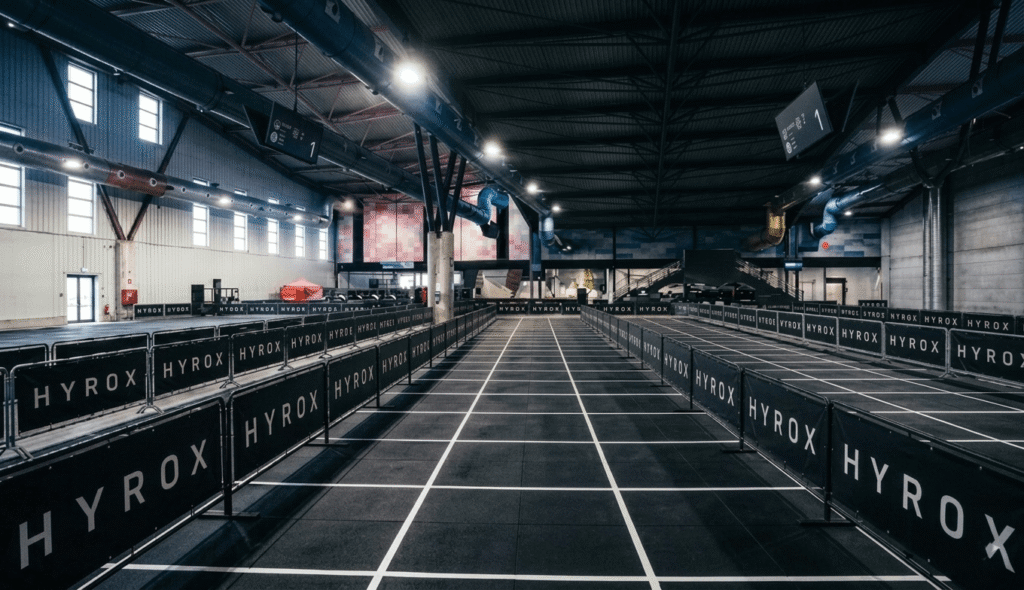
THE 8×8 METHOD — DISTANCE, STATIONS, AND SEQUENCE
The hyrox race format earns its reputation as the «8×8 Method» — eight 1km runs on the track interleaved with eight functional stations, completed in a fixed sequence worldwide. Every HYROX event uses this exact structure.
To understand the hyrox race format at a tactical level, you must analyze the precise breakdown of the distance: 8km total running, passing through the Roxzone for every transition. The clock doesn’t stop.
| # | 1km Run Track | Station | Distance / Load (Open) |
|---|---|---|---|
| 1 | 1km / 0.62miInitial Run | SkiErg | 1,000mConcept2 · Full body pull |
| 2 | 1km / 0.62miTransition via Roxzone | Sled Push | 50mMen: 152kg · Women: 102kg |
| 3 | 1km / 0.62miTransition via Roxzone | Sled Pull | 50mMen: 78kg · Women: 63kg |
| 4 | 1km / 0.62miTransition via Roxzone | Burpee Broad Jump | 80mBodyweight · Min. 1m per rep |
| 5 | 1km / 0.62miBack Four Begins | Rowing | 1,000mConcept2 · Damper 5–6 |
| 6 | 1km / 0.62miTransition via Roxzone | Farmers Carry | 200mMen: 2×24kg · Women: 2×16kg |
| 7 | 1km / 0.62miTransition via Roxzone | Sandbag Lunges | 100mMen: 30kg · Women: 20kg |
| 8 | 1km / 0.62miFinal Transition | Wall Balls | 100 repsMen: 9kg · Women: 6kg |
| 9 | 8km / 4.97miTotal run distance | Race Totals | 8 StationsStandardized Sequence |
The architecture of the hyrox race format has a deliberate logic. Stations 1–4 are the «front four» — the SkiErg, Sleds, and Burpees build the base fatigue before the metabolic challenge of the «back four».
Strength Meets Endurance — The Ultimate Work Capacity Test
What is the HYROX workout? It’s the most honest test of complete athletic capacity ever standardized at scale. By integrating high-intensity functional movements with endurance, the hyrox race format ensures there is nowhere to hide.
The concept of work capacity — the ability to sustain high-quality physical output over time — is the defining metric of the hyrox race format. You can have a 181kg (400lb) deadlift and still stall on the Sled Push at meter 35 because your cardiovascular system is redlining.
Open vs. Pro — What Changes, What Doesn’t
The hyrox rules apply uniformly across all race formats — the same movement standards govern Open, Pro, Doubles, and Relay athletes. What differs between Open and Pro is the equipment weight at the sled stations and Farmers Carry. Here is the full comparison. Primary units: LBS. Metric in parentheses.
Men’s Open vs. Pro — Complete Load Comparison:
| Station | Men’s Open | Men’s Pro | Load Increase |
|---|---|---|---|
| Sled Push | 335 lbs (152kg)50m / 164ft | 441 lbs (200kg)50m / 164ft | +106 lbs / +48kg |
| Sled Pull | 172 lbs (78kg)50m / 164ft | 227 lbs (103kg)50m / 164ft | +55 lbs / +25kg |
| Farmers Carry | 2×53 lbs (2×24kg)200m / 656ft | 2×71 lbs (2×32kg)200m / 656ft | +35 lbs / +16kg |
| Sandbag Lunges | 66 lbs (30kg)100m / 328ft | 66 lbs (30kg)100m / 328ft | SAME |
| Wall Balls | 20 lbs (9kg)10ft (3m) · 100 reps | 20 lbs (9kg)10ft (3m) · 100 reps | SAME |
Men’s Pro Load Jump
Women’s Open vs. Pro — Complete Load Comparison:
| Station | Women’s Open | Women’s Pro | Load Increase |
|---|---|---|---|
| Sled Push | 225 lbs (102kg)50m / 164ft | 335 lbs (152kg)50m / 164ft | +110 lbs / +50kg |
| Sled Pull | 139 lbs (63kg)50m / 164ft | 227 lbs (103kg)50m / 164ft | +88 lbs / +40kg |
| Farmers Carry | 2×35 lbs (2×16kg)200m / 656ft | 2×53 lbs (2×24kg)200m / 656ft | +35 lbs / +16kg |
| Sandbag Lunges | 44 lbs (20kg)100m / 328ft | 44 lbs (20kg)100m / 328ft | SAME |
| Wall Balls | 14 lbs (6kg)9ft (2.7m) · 100 reps | 14 lbs (6kg)9ft (2.7m) · 100 reps | SAME |
Women’s Pro Load Jump
The universal movement standards enforce a non-negotiable quality threshold at every station. No-reps cost you the full energy expenditure of the rep with zero credit — compounding your fatigue load while adding time to your race clock. Know these before your first training session:
Read Guide →
Read Guide →
Read Guide →
Read Guide →
Read Guide →
Read Guide →
Read Guide →
Read Guide →
Mastering Compromised Running — The Hidden Race Within the Race
If you study HYROX race results carefully, you’ll notice that the fastest athletes don’t have the fastest individual station times. They have the most consistent Roxzone run splits. The Roxzone run — the 1km (0.62-mile) corridor between every station — is what experienced coaches call the «9th station» because it determines how much gas you have in the tank at every subsequent station.
Managing the HR Spike After Station 2
Station 2 is the most dangerous heart rate moment in the first half of a HYROX race — and most athletes handle it exactly wrong. Here’s the trap: you exit the Sled Push at 90–95% max HR (after driving 152kg / 335lbs across 50 meters / 164 feet on legs that have already run 2km / 1.24 miles), and you immediately step into the Roxzone.
Athletes who sprint the Roxzone out of the Sled Push arrive at the Sled Pull already redlining. The Sled Pull then pushes them past their lactate threshold. The Burpee Broad Jump at Station 4 — three stations away — becomes a survival exercise instead of a managed effort.
The race-tested protocol: treat the first 200m (656ft) of the Roxzone after the Sled Push as a controlled HR descent, not a sprint. Run at 70–75% perceived effort — nasal breathing if your fitness level supports it — for the opening 200m (656ft). This brings your HR down 8–12 BPM before you lock in your Roxzone pace for the remaining 800m (0.5 miles).
You arrive at Station 3 at 83–86% max HR instead of 95%. That 10-BPM difference determines whether the Sled Pull is manageable or catastrophic. Build this protocol into every training simulation. By race day, it should be automatic.
Pre-Sled Entry: The same principle applies before the Sled Push itself. In the final 200m (656ft) of your pre-Station-2 Roxzone run, consciously drop your pace by 5–8% and take two full nasal breaths. Arrive at the sled at 82–85% max HR, not 96%. Set your foot position, exhale hard, and push with a pace you can sustain for 50 meters (164 feet) — not a pace that maxes you out at meter 20 (66 feet).
The 5-Round Station-Run Ladder
Push at competition weight for 50m (164ft), or perform 10 heavy barbell hip thrusts at 135lbs (61kg)+ if no sled is available. Maintain competition body position throughout.
1km (0.62mi) at your target race pace. Do not rest between the station sim and the run. Time your split. This is your baseline compromised running benchmark.
50m (164ft) at competition weight, or 10 heavy cable rows at maximum resistance. Transition directly to the next run with no rest.
1km (0.62mi) again at race pace. Log how much your split degrades compared to the first run. The degradation gap is your work capacity deficit to close in training.
Rest only between complete rounds (2–3 minutes). Track every split. Chase consistency — your first and fifth run splits should be within 15 seconds of each other when race-ready.
Execution: Perform this drill once per week in your final 6 weeks before race day, progressively increasing loads. This single training pattern addresses more HYROX-specific fitness gaps than any other drill in the preparation toolkit.
How Long Does It Take to Train for HYROX?
The honest answer is: it depends entirely on where your aerobic base and functional strength currently sit — and which of those two pillars is the bigger gap to close. Here’s the realistic breakdown by athlete profile:
Regardless of fitness level, every how to train for hyrox plan must include three non-negotiable pillars:
Where the Clock Never Stops
Technical Advice: Transitions and Pacing
The Roxzone is the transition area connecting the 8km (4.97-mile) running track to the functional stations. How you manage your transitions through this zone determines your official race time more than any individual station performance.
Know your target 1km (0.62-mile) split and hold it consistently on the track. Running the first three laps at PR pace and the final five at survival pace is a recipe for a slow finish.
Use the final 100–200m of each run as a transition into the Roxzone. Shake out your grip, open your hands, and let your HR descend before tackling the next station.
Use the aid stations located within the Roxzone. Dehydration at Station 5 is a race-ender. Take fluid in the first four transitions before your body demands it.
Don’t think about the full race. Focus only on the current 1km lap and the upcoming station. Mental segmentation reduces perceived exertion significantly.
The transition between Stations 3 and 4 is your reset moment. Arrive at the Burpee Broad Jump in control to dominate the «Back Four».
You spend more time running on the track than at any station. Use race-specific shoes to handle 8km of hard arena floors and protect your calves.
Your Technical Deep-Dive Library
Every station within the hyrox race format has a dedicated technical guide covering biomechanics, competition weights, and pacing strategy.
The hyrox race format is understood. Now Master Every Station.
Your race time is the sum of eight individual station performances. Every guide is built with the same standard of technical authority — because your race deserves nothing less.